Life at Sea: How Container Ship Crews Work and Live
A modern container ship longer than four football fields, carrying cargo worth hundreds of millions of dollars, is typically operated by a crew of only about twenty people. Who are they, what do they actually do all day, and what is life like during months at sea? The answers reveal one of the least visible professions behind globalization.
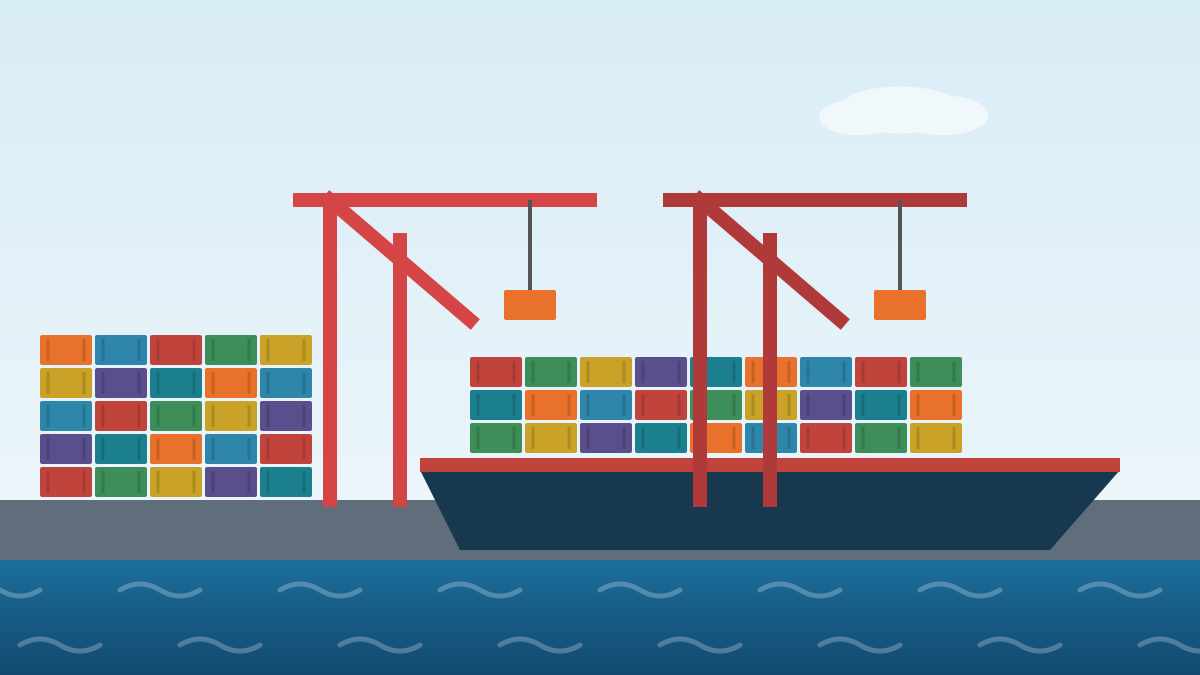
The structure of a ship's crew
Every merchant ship divides its crew into two main departments. The deck department, led by the captain (master) and chief officer, is responsible for navigation, cargo operations, safety, and the overall command of the vessel. The engine department, led by the chief engineer, keeps the enormous main engine, generators, and all mechanical systems running around the clock. A cook and stewards complete the team, because a ship is not only a workplace but a home.
Ranks follow a clear ladder: cadets learn the trade, ratings perform skilled manual work, officers stand watch and manage departments, and the captain carries final legal responsibility for ship, cargo, and crew.
A day organized around watches
The sea never closes, so the ship never sleeps. Navigation and engine supervision run on a watch system — traditionally four hours on duty, eight hours off, repeated day and night. An officer on the bridge monitors traffic, weather, and the route; meanwhile, maintenance work fills the daytime hours: inspecting equipment, fighting rust, testing safety systems, and preparing for the next port.
Port days are the most intense. Arrivals can happen at any hour, and cargo operations run continuously, with the crew supervising loading plans, ballast adjustments, and the securing of container stacks — all under time pressure, because every extra hour at berth costs money.
Months away from home
Seafarers typically work on contracts lasting several months aboard, followed by leave at home. Life on board means a private cabin, shared meals, a small gym or recreation room, and — increasingly — limited internet that has transformed morale by connecting crews with their families. Even so, the profession demands real sacrifice: birthdays missed, time zones crossed weekly, and a social world limited to the same small team for months.
Crews are strikingly international. It is normal for one vessel to combine officers and ratings from several different countries, working in English, the official language of the sea. The Philippines, India, China, Indonesia, and Eastern European countries are among the largest suppliers of the world's roughly two million seafarers.
Training and responsibility
Operating a modern vessel is a highly technical career. Officers study for years at maritime academies, obtain internationally recognized certificates, and retrain continually on navigation systems, firefighting, first aid, and survival techniques. The engine room of a large ship is a floating power station; its bridge is closer to an aircraft cockpit than to the wooden wheel of popular imagination.
Why this profession matters to everyone
During global crises, seafarers have been formally recognized as key workers — and for good reason. Food, medicine, fuel, and virtually every manufactured product depend on crews willing to spend months away from home. When crew changes were disrupted during the pandemic, hundreds of thousands of seafarers were stranded aboard beyond their contracts, a humanitarian problem that exposed how invisible this workforce usually is.
Conclusion
Behind every container delivered on time stands a small team living between sky and water. The next time a delivery arrives at your door, remember that part of its journey was watched over, at three in the morning, by an officer on a darkened bridge in the middle of an ocean.
Sources & Further Reading
- UNCTAD — Review of Maritime Transport: unctad.org
- International Maritime Organization (IMO): imo.org
- World Shipping Council: worldshipping.org